Posts

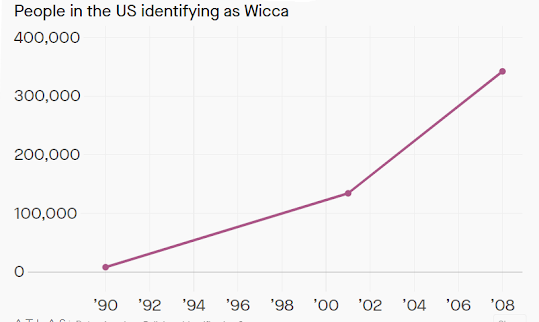
Graph: Increase in People Identifying as Wiccan

Image
This is a graph of the recent rise in people who are identifying as Wicca. As we can see, in just 18 years the religion has grown by almost 400,000 people, with the biggest increase starting in '01.  Kopf, Dan, and Sangeeta Singh-Kurtz. “The US Witch Population Has Seen an Astronomical Rise.” Quartz , Quartz, 2018, qz.com/quartzy/1411909/the-explosive-growth-of-witches-wiccans-and-pagans-in-the-us/.  

Revised Research Question and Sources

  What drives women of all ages to become a part of Wicca and witchcraft? How do these women use Wicca as a political angle and why do many communities within Wicca deny this political side of their religion? Sources: Jarvis, Christine. “Becoming a Woman Through Wicca: Witches and Wiccans in Contemporary Teen Fiction.”  Children’s Literature in Education , vol. 39, no. 1, Springer Netherlands, 2008, pp. 43–52, doi:10.1007/s10583-007-9058-0 Warwick, Lynda L. “Feminist Wicca: Paths to Empowerment.”  Women & Therapy , vol. 16, no. 2-3, Taylor & Francis Group, 1995, pp. 121–33, doi:10.1300/J015v16n02_13.    Fine, Julia C. “MagicResistance: Anti ‐ Trump Witchcraft as Register Circulation.”  Journal of Linguistic Anthropology , vol. 30, no. 1, 2020, pp. 68–85, doi:10.1111/jola.12249 Magliocco, Sabina. “ Witchcraft as Political Resistance.”  Nova Religio , vol. 23, no. 4, 2020, pp. 43–68, doi:10.1525/nr.2020.23.4.43. Smith, Thomas Aneurin. “ Witchcra...
Literature Review 3

Image
  Resisting Rhetorics of Violence: Women, Witches, and Wicca by Jo Pearson Citation: Pearson, Jo. “Resisting Rhetorics of Violence: Women, Witches and Wicca.”  Feminist Theology , vol. 18, no. 2, SAGE Publications, 2010, pp. 141–59, doi:10.1177/0966735009348669. https://journals-sagepub-com.proxy.libraries.rutgers.edu/doi/abs/10.1177/0966735009348669 Summary:           Pearson covers the history of the violence against witches and the different types of violence that not just witches, but all women face. It also speaks about the kind of violence that the witch can cause against others witch magic or revenge. She talks about the three different types of witches being Daly-an, Starhawkin, and Wiccan and how they differ from each other when it comes to empowerment and its depictions of violence. Author:           I could not find anything about Jo Pearson, as the only results t...

Literature Review 2

Image
  Witchcraft as Political Resistance: Magical Responses to the 2016 Presidential Election in the United States Citation: Magliocco, Sabina. “ Witchcraft as Political Resistance.”  Nova Religio , vol. 23, no. 4, 2020, pp. 43–68, doi:10.1525/nr.2020.23.4.43. https://rutgers.primo.exlibrisgroup.com/discovery/fulldisplay?docid=cdi_crossref_primary_10_1525_nr_2020_23_4_43&context=PC&vid=01RUT_INST:01RUT&lang=en&search_scope=MyInst_and_CI_2&adaptor=Primo%20Central&tab=Everything_except_research&query=any,contains,witchcraft%20as%20political%20resistance&offset=0   Summary: Magliocco describes the ways in which many people use witchcraft to combat the Trump administation and the 2016 election. This article gives many different cases where many would use spells and rituals in order to bind Trump and stop him from performing evil deeds making a huge impact on the country. It also talks about how many different people have found Wicca an...

Literature Review 1

Image
  Literature Review #1   Feminist Wicca: Paths to Empowerment by Linda L. Warwick Warwick, Lynda L. “ Feminist Wicca: Paths to Empowerment .” Women & Therapy, vol. 16, no. 2-3, Taylor & Francis Group, 1995, pp. 121–33, doi:10.1300/J015v16n02_13. https://search-proquest-com.proxy.libraries.rutgers.edu/docview/216249883/fulltextPDF/103DA2C915E348D0PQ/1?accountid=13626   Summary: Warwick’s article is about the different ways in which Wicca inspires and encourages women to feel empowered and to the be best versions of themselves. It describes the beliefs in Wicca that empower women, like the worship of the Goddess which represents, Maiden, Mother, and Crone. It also explains the ways in which Wicca is accepting of lesbians and homosexuality, and how that can create a safe space for people in the LGBTQ community where other religions do not. Author: Lynda Warwick is a doctoral candidate at Miami University, a Ph.D. in psychology. She studied hum...

Research Question and sources

  I am doing my research project on the study of witches and witchcraft. An extremely important topic is Wicca, the religion that witches practice in modern society. I think it is important to study Wicca in order to understand witches. Research Question : Why does t he world depict witches and Wicca as a false religion and in a negative light? What drives a woman to become a part of Wicca and to follow this normally taboo way of life? Source 1: Jarvis, Christine. “Becoming a Woman Through Wicca: Witches and Wiccans in Contemporary Teen Fiction.”  Children’s Literature in Education , vol. 39, no. 1, Springer Netherlands, 2008, pp. 43–52, doi:10.1007/s10583-007-9058-0. This scholarly article is about what drives young girls towards witchcraft and Wicca. It is about why they find this spiritual connection to the pagan religion and what allows them to find their identity and feel positive about their life.   Source 2: Harris, Adrian. “Wicca and the Christian Heritage...

Wicca and Magick

Image
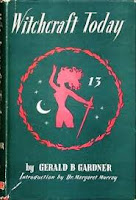
  You cannot discuss the topic of witchcraft without diving deep into Wicca. Wicca is a modern Pagan “religion” developed in the early twentieth century. I put religion in quotation marks because it is not formally known as a religion, nor do many scholars and people a part of Wicca call it that. Many refer to it as a nature religion, a mystery religion, or a “magico-religion,” due to the practice of magic. Many practitioners prefer to call Wicca a “spirituality,” and “way of life,” as opposed to religion. Diving into Research           The keywords that I used in my search were simple: “witchcraft today,” “magic,” or “witches,” every single one of these coming up with a connection to Wicca. It brought me to the book, Witchcraft Today, published in 1954 by Gerald Gardner, the first author to announce Wicca to the general public and considered to be the father of Wicca. This book was used often by practitioners and is essentially the ...